


Page 29 - Inspire Magazine
P. 29
When we select research projects to fund, we give priority to two key areas: early detection and the patient
        experience.

        As Bill Simpson’s story clearly shows (read ‘The man who got scanned’ on pages 3-5), checking high-risk individuals
        for early-stage lung cancer using low dose CT (LDCT) scans really works.


        In fact, LDCT scans have been shown to reduce deaths from lung cancer by 26% compared with using chest
        X-rays alone. That’s why our charity is pushing so hard for the roll-out of lung health checks across the UK.
        We hope that local pilot schemes such as our Nottingham project will provide vital evidence showing the real
        effectiveness of CT scans in early detection.


                                       So far, so good – but what about patients? How do they feel about being asked to become
                                         involved in such checks? For many people, the merest suggestion that they’re being
                                           investigated for lung cancer can be a worrying prospect. Any medical procedure carries
                                            some level of risk, however small. And what about patients whose test results show up
                                              abnormalities – how do we reassure them?

                                                This is why we backed a study looking into the experience of patients involved in
                                                 such checks.


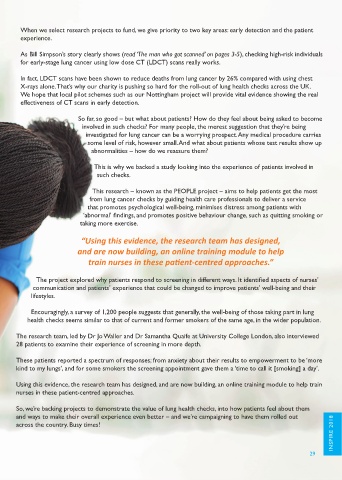
                                               This research – known as the PEOPLE project – aims to help patients get the most
                                             from lung cancer checks by guiding health care professionals to deliver a service
                                            that promotes psychological well-being, minimises distress among patients with
                                          ‘abnormal’ fi ndings, and promotes positive behaviour change, such as quitting smoking or
                                        taking more exercise.


                              “Using this evidence, the research team has designed,
                             and are now building, an online training module to help
                                 train nurses in these pati ent-centred approaches.”


              The project explored why patients respond to screening in different ways. It identifi ed aspects of nurses’
                communication and patients’ experience that could be changed to improve patients’ well-being and their
               lifestyles.


               Encouragingly, a survey of 1,200 people suggests that generally, the well-being of those taking part in lung
             health checks seems similar to that of current and former smokers of the same age, in the wider population.

       The research team, led by Dr Jo Waller and Dr Samantha Quaife at University College London, also interviewed
       28 patients to examine their experience of screening in more depth.


       These patients reported a spectrum of responses; from anxiety about their results to empowerment to be ‘more
       kind to my lungs’, and for some smokers the screening appointment gave them a ‘time to call it [smoking] a day’.

       Using this evidence, the research team has designed, and are now building, an online training module to help train
       nurses in these patient-centred approaches.

       So, we’re backing projects to demonstrate the value of lung health checks, into how patients feel about them
       and ways to make their overall experience even better – and we’re campaigning to have them rolled out
                                                                                                                        INSPIRE 2018
       across the country. Busy times!


                                                                                                                29

